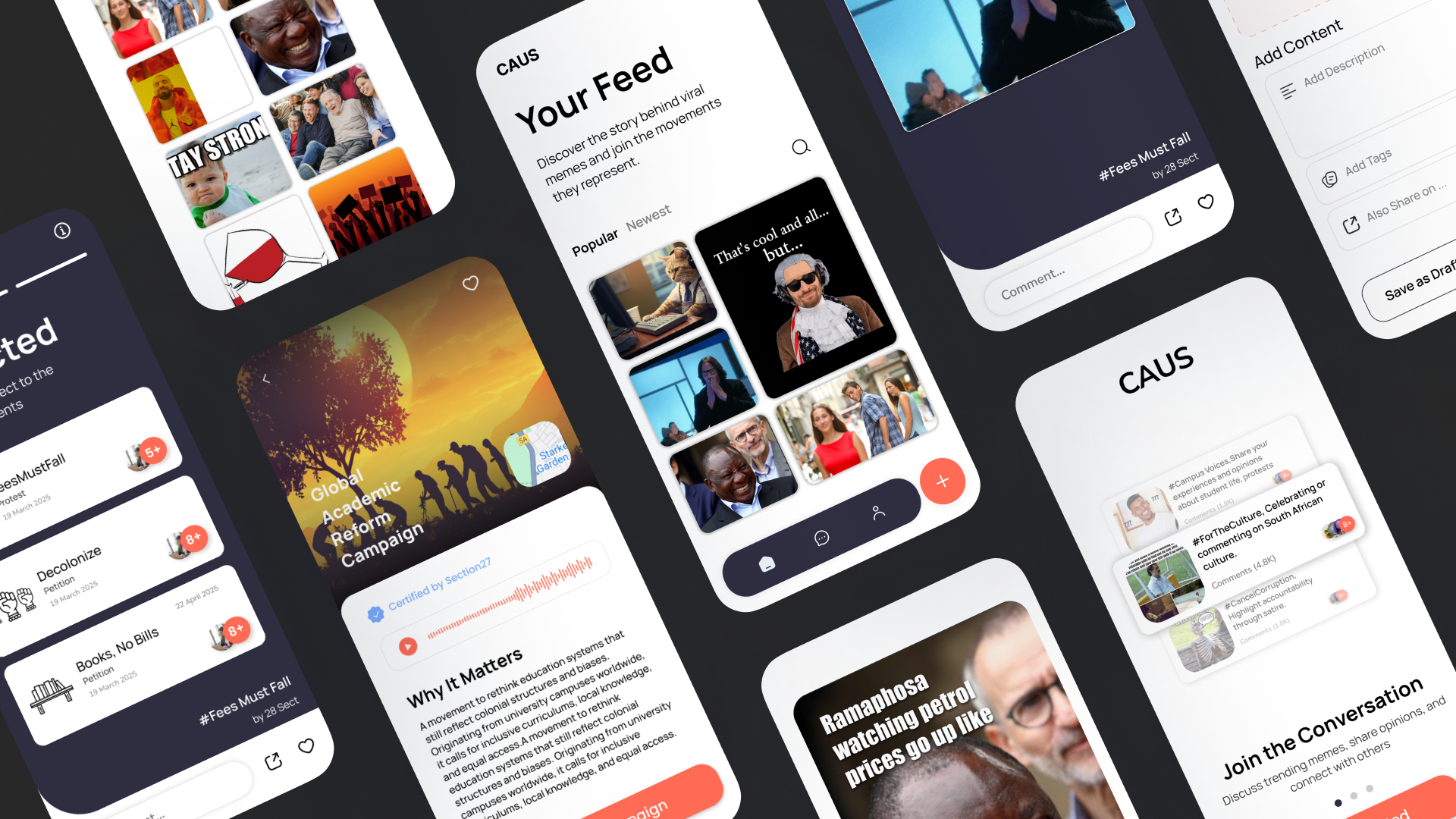


How do South African political memes use visuals and language to resist and challenge dominant digital narratives?
01 — Design Brief
What am I designing?
This module takes the research from RP300 and turns it into a digital product that responds to the issues identified in it. It begins with blue-sky discussion, then moves into a proposal and a clear project plan before any design work starts.
My RP300 paper, Meme Culture and Digital Resistance in South Africa: Visualizing Political and Social Activism in the Digital Age, asked how South African political memes use visuals and language to resist and challenge dominant digital narratives. Caus. is the attempt to build something out of that question rather than only write about it.
The theory it's built on
- Memes are cultural artefacts, not just images
- They spread through imitation, remix and participation
- Humour becomes political commentary
- Countervisuality — "the right to look"
- Memes become counter-visual tools
- Reclaiming the power to represent political events
- Writes about affect, visibility and postcolonial digital culture in South Africa
- Explains why memes in SA hit so hard
02 — Approach
How did I approach the problem?
Eight weeks, worked through in sequence — but I let the research overturn the framing rather than treating the concept as settled. The survey in the middle of the project changed what the app was for.
03 — Research
What did I discover?
I ran a survey of 21 people, mostly aged 18–24, alongside an empathy map and an audit of two existing platforms. I wanted to know two things: whether people actually treat memes as political, and whether anything happens after they share one.
The first question answered itself quickly. 81% had shared or seen a meme about a political or social issue, roughly 45% share memes daily, and 81% thought memes were an effective way to spread awareness. Motivation split between entertaining or provoking thought (47.6%) and criticising or satirising something (33.3%). The second question is where it got interesting.
So the audience believed in the reach and doubted the outcome. What did move people was specific: 57.1% said they'd take real-world action if it was an issue they already cared about, 19% if the meme came from a source they trusted, and 14.3% if taking part felt safe and accessible. 55% said they would attend an in-person event that started as an online meme campaign — which sits oddly against the 61.9% who never had. The intent is there; something in between is missing.
What the empathy map surfaced
- Curious about social causes, but prefers low-pressure, entertaining ways in
- Sceptical about whether memes lead to "real" change
- Empowered when a post gets reactions or spreads awareness
- Frustrated when activism feels too serious, preachy or hard to access
- Safer engaging when friends are already involved
- Hears about social and political issues through memes, friends and influencers rather than traditional media
- Campaign awareness spreads through viral sounds and TikTok trends
- Friends repost trending topics in Instagram stories and WhatsApp groups
- Influencers and meme pages shape what feels "relevant" to support
- Mixed opinions — some treat meme activism as powerful, others dismiss it as "slacktivism"
- A constant flow of funny, sarcastic or ironic memes on Instagram and TikTok
- Campaigns and protests shared visually — posters, hashtags, screenshots
- More people participating online than turning up offline
- Likes and reach metrics read as signs of influence or impact
- Trending issues rotate fast; yesterday's cause is old news
- "I share memes daily, mostly to entertain or make people think"
- Lives on Instagram, WhatsApp and TikTok
- Engages with political memes but rarely attends real-world events
- "If it's an issue I care about, I might actually take action"
- Would use a meme tool if it were intuitive and easy to share

- Humour is the gateway to engagement
- Ease of use, analytics and community validation are what users value
- People want to feel their posts matter — measurable impact
- Make participation fun, gamified and measurable
- Show impact — post reach, protest map
- Encourage group action: "your friends are joining this campaign"
- Activism feels performative — sharing doesn't feel like change
- Information overload; causes compete for attention
- Low trust in memes and the campaigns behind them
- No route from an online reaction to an offline one
Humour is the gateway — people engage with causes when it doesn't feel preachy. But the pains clustered tightly: activism feeling performative, information overload as causes compete for attention, uncertainty about whether a meme or the campaign behind it is credible, and no clear route from an online reaction to an offline one.
Competitor analysis
I looked at Global Citizen and Ground News. Global Citizen already blends activism with entertainment and rewards participation with points, but its navigation — Festival, For You, Discover, Goals & Journeys — is vague and overlapping, and points appear everywhere without explaining what they convert into.
Ground News was the more useful failure. It exposes media bias brilliantly by showing left, centre and right coverage side by side, which is a genuinely counter-visual move. But the bias meter is passive: it tells you the split without explaining how the narratives differ. It's a dashboard, not a conversation. News is observed, never co-created — the exact opposite of how meme culture works, where critique becomes shared authorship. That contrast defined what Caus. needed to be.
Humour is the gateway — people engage with causes when it doesn't feel preachy. But the pains clustered tightly: activism feeling performative, information overload as causes compete for attention, uncertainty about whether a meme or the campaign behind it is credible, and no clear route from an online reaction to an offline one.
Competitor analysis
I looked at Global Citizen and Ground News. Global Citizen already blends activism with entertainment and rewards participation with points, but its navigation — Festival, For You, Discover, Goals & Journeys — is vague and overlapping, and points appear everywhere without explaining what they convert into.
Ground News was the more useful failure. It exposes media bias brilliantly by showing left, centre and right coverage side by side, which is a genuinely counter-visual move. But the bias meter is passive: it tells you the split without explaining how the narratives differ. It's a dashboard, not a conversation. News is observed, never co-created — the exact opposite of how meme culture works, where critique becomes shared authorship. That contrast defined what Caus. needed to be.
People believe memes raise awareness but doubt they produce action.
Decision Every meme in the app links directly to the campaign, petition or protest behind it, so the action is one tap from the joke.
Ground News shows you bias but gives you nowhere to respond to it.
Decision A remix page sits at the centre of the product — users download, edit and repost memes, making participation part of consuming.
Analytics was the single most requested feature (52%), and users said they couldn't tell whether their posts mattered.
Decision Post reach and engagement surface on the profile, so impact is visible rather than assumed.
Global Citizen's tab names didn't communicate what was inside them.
Decision Four plainly named sections — Meme, Did You Know, Connection, Movement.
Who are the users?
Three users, chosen because they sit at different distances from the problem: someone fluent in meme culture but stuck at reposting, someone sceptical of it, and an organisation that needs the reach but can't produce the content.
Primary

Kayla Alex, 20
Frustrations
- Activism can feel overwhelming or performative
- Unsure what's real or trustworthy online
- Protest organising is scattered across multiple apps
Goals
- Express opinions and raise awareness creatively
- Be part of social movements without feeling pressured
- Measure impact — who saw or engaged with her post
Secondary

Mark Ace, 48
Frustrations
- Finds memes confusing or disrespectful toward serious issues
- Doesn't engage on newer platforms like TikTok
- Sceptical of online movements without visible action
Goals
- Understand youth perspectives and connect with them
- See social causes communicated respectfully
- Promote credible information and civic responsibility
Organisation

Growth Foundation
Frustrations
- Lacks digital marketing and meme-creation skills
- Hard to stay visible against large NGOs
- Uncertain how to engage meme-savvy youth authentically
Goals
- Reach and mobilise youth through online campaigns
- Track post reach and engagement
- Turn online awareness into real-world participation
04 — Defining Problems
What problems did I identify?
Memes spread awareness, but they rarely lead to real action.
A meme can reach more people faster than a news article, and the audience knows it. What's missing is the step after the share — nothing in the platforms people already use connects a meme to the campaign, petition or event it's actually about.
People are uncertain whether a meme, or the campaign behind it, is credible. 19% said they'd only act on something from a trusted source, and "unsure what's real online" appeared across both the empathy map and the personas.
Organising is scattered across multiple apps, and causes rotate fast — yesterday's issue is old news before anyone turns up to anything. There's no single place where a cause, its content and its events sit together.
05 — Ideation
What solutions did I explore?
I explored the features people actually asked for in the survey rather than the ones I found most interesting to design. The survey's feature question gave me a ranked list to work from, and I weighted each one against whether it closed the awareness-to-action gap or just made the app busier.
How I prioritised
06 — Design Process
How did I turn ideas into an interface?
The structure came before the styling. If the core idea was that a meme should always lead somewhere, the architecture had to make that path short — which meant the meme detail page became the hinge of the whole product.
Information architecture
Onboarding leads into the home page, which branches into eight areas: home feed, meme details, remix, map, profile, forum, petition and protest. Petitions and protests both link back to the meme that surfaced them, so the loop closes in both directions. Sharing or completing an action earns points.
The flow that mattered most
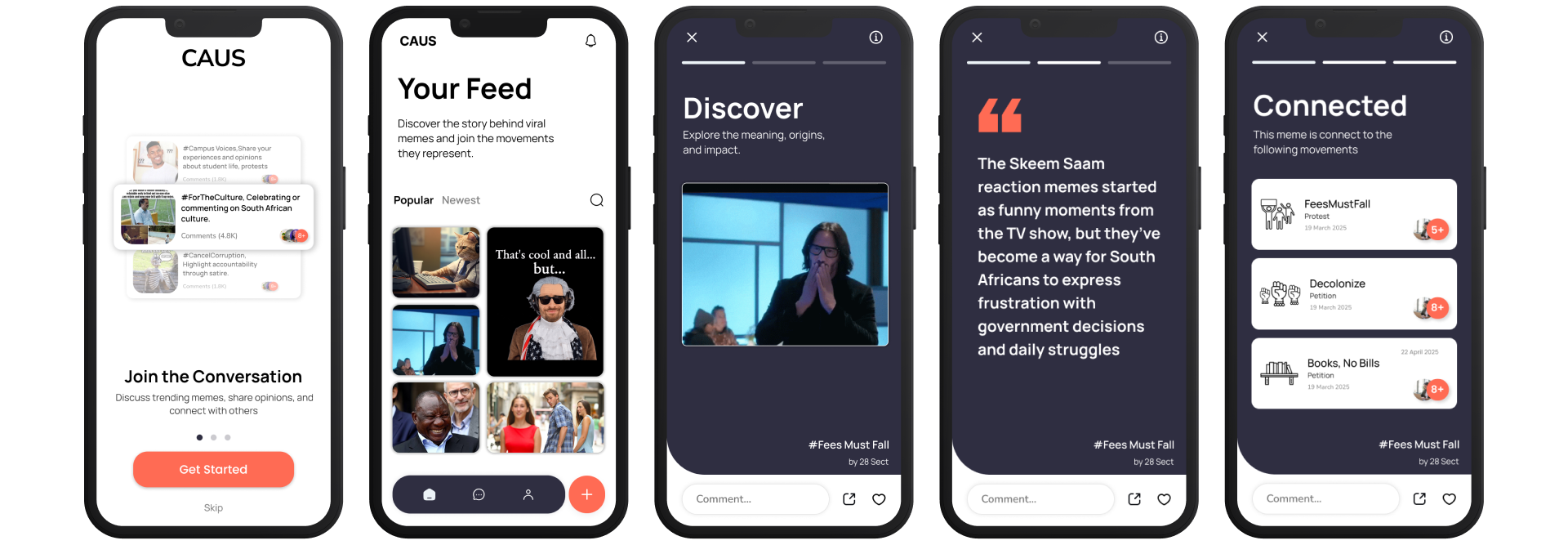
Feed → Story → Call to action → Taking action → Sharing
Wireframes
Simple, low-fidelity layouts that show the basic structure and flow of the interface, without detailed design elements — enough to test whether the path from meme to action held up before committing to visuals.
Visual System Choice
Bittersweet (#FF6B54) as primary against Space Cadet (#2F2E41), with Alice Blue (#ECF3F7) and Lavender (#CFDCEF) as accents. Poppins throughout. The palette had to carry humour without looking like a joke app — warm enough to feel social, dark enough that a petition doesn't look out of place next to it.
07 — Final Design
What does the final design look like?
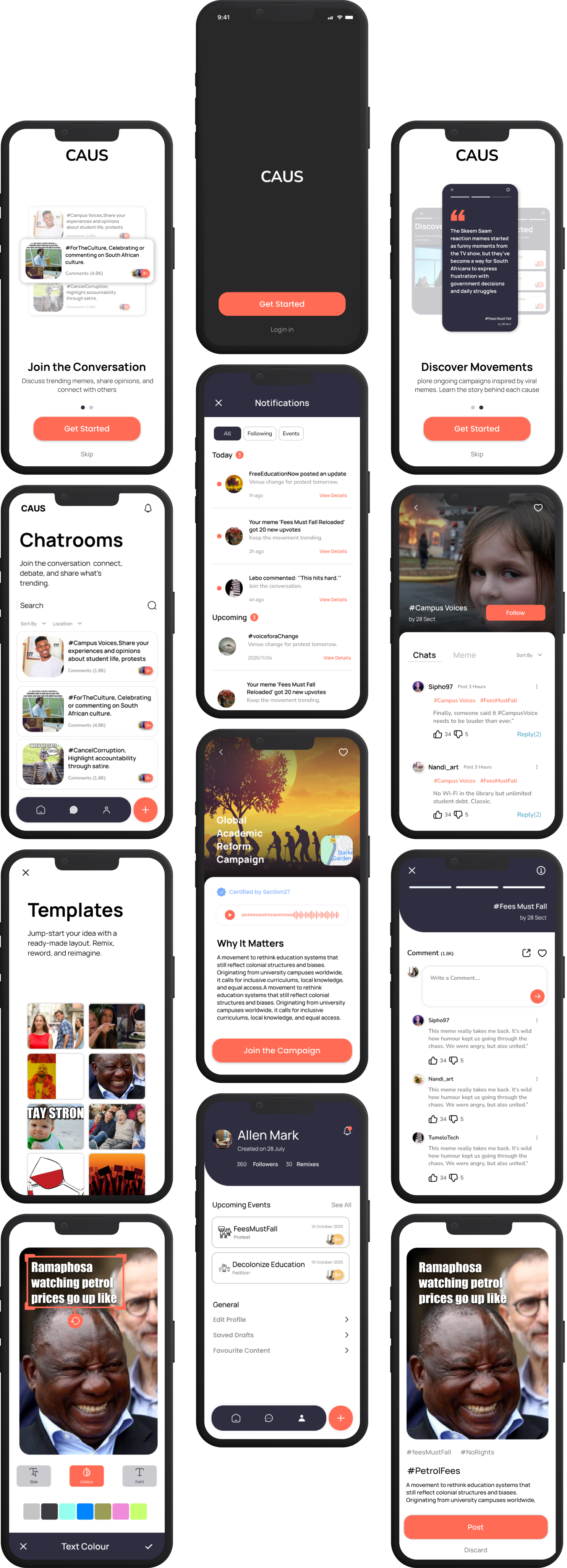 View the prototype ↗
07 — Reflection
What did I learn?
The most useful thing that happened in this project was being contradicted by my own survey. I went in from a research paper about how memes resist dominant narratives, which had already convinced me memes were powerful. The survey agreed — and then said, by a majority, that memes wouldn't get disengaged people to act. I could have designed around that, or treated it as the brief. Taking it as the brief is what turned Caus. from a meme app into an app about the distance between reacting and doing.
Ground News taught me more than the direct competitors did. It's a well-made product solving a real problem, and its weakness is structural rather than visual: it positions the user as an observer. Noticing that is what made me put remixing at the centre of Caus. rather than treating it as a side feature.
What I'd change: I didn't run usability testing within the eight weeks, and that's the clearest gap in the project. The whole design rests on an untested assumption — that a link from a meme to a petition actually gets tapped. I'd also want to test whether the points system motivates people or does the opposite, since the same survey that showed 57.1% interested in gamification also showed a widespread suspicion of activism that feels performative. Rewarding shares could easily reinforce the exact behaviour the app was built to move past.
I'd also want a bigger sample. 21 responses, heavily weighted toward 18–24, is enough to find a tension but not enough to size it.